WHEN JUSTICE COMMITS THE CRIME
Thoughts from the Editor
Justice is supposed to be the stabilizing force in a free society. It is meant to be slow when it needs to be slow, careful when the stakes are high, and fair even when fairness is inconvenient. It is not supposed to be efficient at the expense of truth, nor powerful at the expense of rights.
Yet what I have witnessed—first in the case of Ashlynn Perigo, and now in the case of Bobby Ray Rufus McDonald—suggests something far more troubling than individual error. Justice has not merely failed. It has lost its meaning.
This series exists because what I am seeing can no longer be explained away as bad luck, isolated misconduct, or the inevitable rough edges of law enforcement. The patterns are too consistent. The incentives are too well aligned. The outcomes are too predictable. What presents itself as a criminal justice system increasingly resembles a closed loop—one that protects itself far more effectively than it protects the public.
Plea agreements have become the backbone of that loop. Not as a voluntary resolution between equals, but as a pressure mechanism designed to avoid trials altogether. Defendants are encouraged—sometimes subtly, sometimes aggressively—to surrender their constitutional right to trial not because the evidence has been tested, but because the system itself is hostile to anyone who insists on testing it. Trials are treated as disruptions. Speed is rewarded. Resistance is punished.
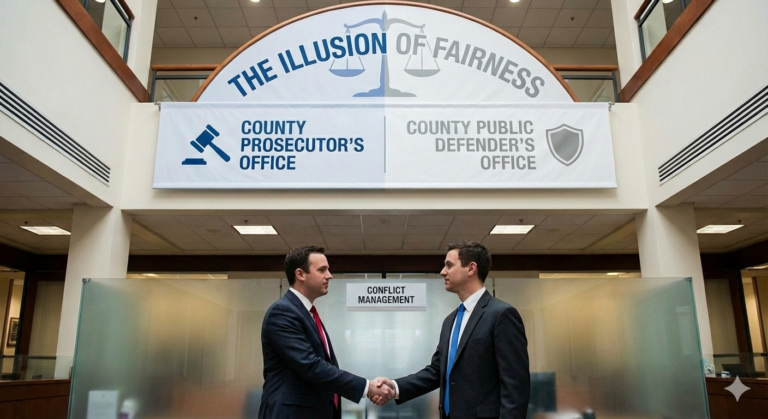
Layered beneath this is a structural conflict that rarely gets discussed honestly. Prosecutors and public defenders are funded by the same county authority, operating within the same political and budgetary ecosystem. Ethical rules insist this arrangement is benign. Reality suggests something more complicated. Independence on paper does not always translate into independence in practice, especially in a system that prioritizes throughput over confrontation.
Policing practices feed this pipeline, and they do so under the broad shield of qualified immunity. In theory, qualified immunity exists to protect officers from frivolous lawsuits. In practice, it has become a near-absolute barrier to accountability, insulating police conduct even when constitutional boundaries are pushed—or crossed. When officers know that civil consequences are unlikely, incentives shift. Stops become looser. Searches become broader. Detentions become longer. Mistakes are absorbed by the system rather than corrected by it.
Qualified immunity does not operate in isolation. It reinforces a culture where aggressive policing carries little personal risk, where suppression issues are rarely litigated to the end, and where constitutional violations are treated as procedural inconveniences rather than serious breaches. When misconduct is effectively unpunishable, it stops being aberrational and starts becoming routine.
The routine use of criminal defendants as informants is one of the clearest examples of this distortion. Vulnerable individuals—often struggling with addiction, poverty, or desperation—are leveraged into cooperation and sent back into dangerous environments without training, protection, or meaningful oversight. Their safety becomes expendable. The information they provide is treated as credible despite overwhelming incentives to fabricate or exaggerate. This is not community policing. It is risk outsourcing.
Prosecutorial culture compounds these problems. Charging discretion is immense. Oversight is minimal. Success is often measured in convictions rather than correctness. Overcharging becomes leverage. Plea offers become ultimatums. Justice becomes transactional.
The human cost of this system is rarely centered. Defendants are reduced to case numbers. Families are destabilized. Lives are altered permanently long before guilt or innocence is meaningfully tested. The emotional, psychological, and economic consequences ripple outward, largely unacknowledged.
Equally concerning is the silence that surrounds all of this. Local media frequently relies on official narratives, reproducing press releases and charging documents with little scrutiny. When law enforcement and prosecutors control the story, the public never sees the system tested—only affirmed.
Perhaps the most dangerous consequence of this structure is the quiet erosion of trial advocacy itself. Criminal defense attorneys are trying fewer cases to verdict. Trial skills are perishable. When they go unused, they dull. I have watched suppression issues that should have been aggressively litigated barely pressed at all. In at least one instance, the defense presentation was so disorganized that even a lay observer could see opportunities left unexplored. This is not about personal failure; it is about what happens when a system discourages trials so effectively that even trial lawyers lose the room.
Overlaying all of this are Indiana’s risk assessment systems, which promise objectivity but often amplify bias, punish poverty, and substitute algorithms for individualized judgment. These tools shape pretrial detention decisions while operating largely beyond public understanding or meaningful challenge.
This series is not written out of spite, nor is it an attack on any single individual. It is an examination of a structure—how it operates, who it protects, and who it consumes. The failures described here are not anomalies. They are the predictable result of a system optimized for efficiency, leverage, and insulation from accountability.
Each installment will examine one component of that system in detail: plea bargaining, conflicts of interest, qualified immunity, informant use, prosecutorial power, policing practices, defense erosion, risk assessment tools, human consequences, and media silence. Piece by piece, the goal is to show how justice, as practiced, has drifted dangerously close to becoming the very thing it claims to oppose.
Justice does not collapse all at once. It erodes quietly—behind procedure, habit, and legal shields designed to prevent scrutiny. This series exists to name that erosion clearly, carefully, and publicly.
— Editor, Jimmie L. Clayton, Jr.