WHEN JUSTICE COMMITS CRIME: PART 1
POLICING: THE POINT OF ORIGIN
In Indiana, every failure that follows in the criminal justice system begins at the same place: the first encounter between law enforcement and the citizen.
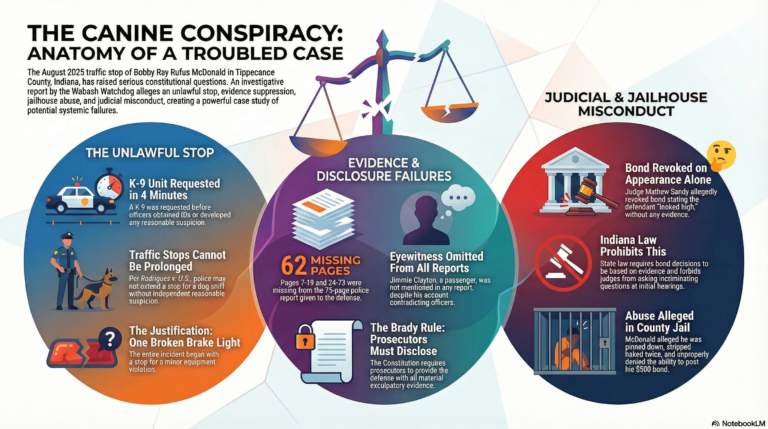
Before there is a charging decision, before a public defender is appointed, before a risk assessment score is generated under Indiana’s pretrial framework (see Indiana Code § 35-33-8-1 et seq.), there is a stop. That stop—often justified by a minor traffic infraction, equipment issue, or an officer’s subjective interpretation of behavior—is where the machinery of justice is set in motion.
This is where power first meets the citizen.
Pretextual Stops and Discretionary Enforcement
Indiana law grants broad discretion to law enforcement at the stop level. A traffic stop is lawful so long as an officer has probable cause to believe a traffic law has been violated, no matter how minor (Whren v. United States, 517 U.S. 806 (1996); applied in Indiana in State v. Quirk, 842 N.E.2d 334 (Ind. 2006)). Courts have consistently held that the officer’s subjective intent is irrelevant so long as an objective basis exists.
This legal framework permits what are commonly known as pretextual stops—encounters that are legally justified but functionally exploratory. Equipment violations, lane deviations, or momentary infractions become gateways to broader investigation.
Legality, however, is not the same as justice.
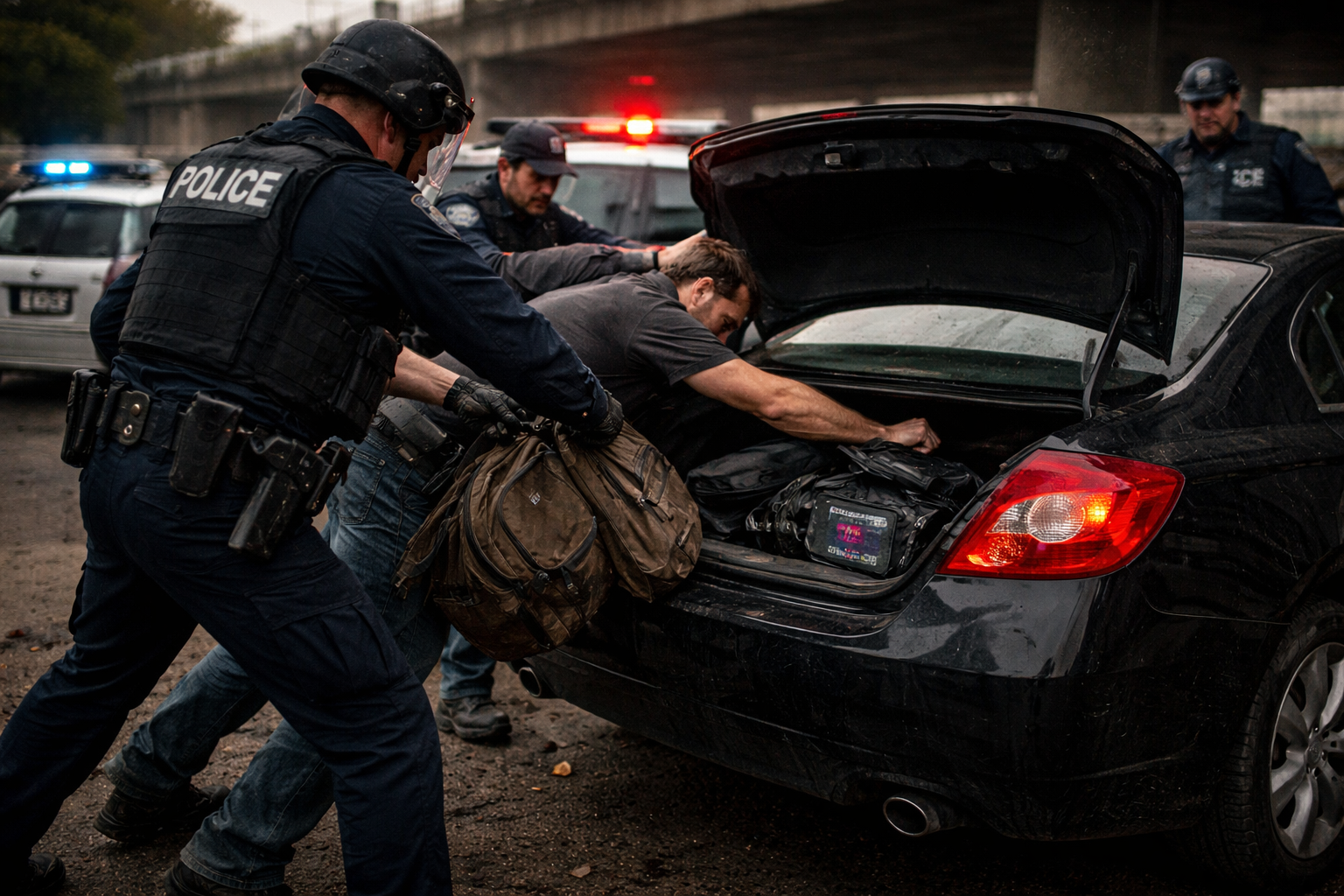
These encounters are rarely about the stated offense. They are about access: access to question, to detain, to run records, and potentially to search. Once contact is initiated, the balance of power shifts immediately in favor of the state.
Indiana appellate courts have upheld this discretion repeatedly, reinforcing a system where enforcement decisions are shaped less by seriousness of offense and more by opportunity. The result is not evenly distributed scrutiny, but concentrated contact with certain individuals and communities.
Low Evidentiary Thresholds at the Arrest Stage
Under Indiana law, an arrest requires only probable cause (Indiana Code § 35-33-1-1). Probable cause exists when the facts and circumstances known to the officer would warrant a person of reasonable caution to believe an offense has been committed (Gaddie v. State, 10 N.E.3d 1249 (Ind. 2014)).
This is a deliberately low threshold.
At the moment it matters most, an officer’s narrative—often uncorroborated and unchallenged—becomes sufficient to deprive a person of liberty. That deprivation carries immediate consequences: detention, booking, bond conditions, employment loss, family disruption, and housing instability.
Indiana courts have acknowledged that arrest is a significant intrusion on liberty, yet the system tolerates that intrusion based almost entirely on the officer’s account (Dixon v. State, 985 N.E.2d 720 (Ind. Ct. App. 2013)).
The arrest itself becomes punishment long before guilt is established.
Volume Policing Over Serious Crime Investigation
Indiana’s criminal justice infrastructure is built to process cases efficiently. Low-level arrests generate predictable cases that move quickly through courts structured for resolution rather than scrutiny. This aligns with the reality that more than ninety percent of criminal cases resolve without trial.
Volume policing favors measurable outputs—stops, arrests, filings—over complex investigations that demand time and resources. Indiana’s courts have implicitly endorsed this model by prioritizing docket efficiency while rarely interrogating the systemic effects of pretextual enforcement.
The system excels at processing people. It struggles to address harm.
Qualified Immunity at the Point of Contact
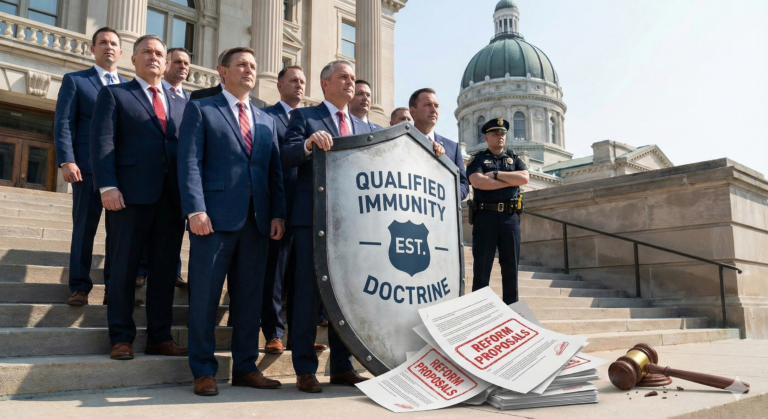
Overlaying Indiana policing is the federal doctrine of qualified immunity, which shields officers from civil liability unless they violate a constitutional right that was “clearly established” at the time of the conduct (Harlow v. Fitzgerald, 457 U.S. 800 (1982); Pearson v. Callahan, 555 U.S. 223 (2009)).
In practical terms, this means that even when Indiana courts find a constitutional violation occurred, civil accountability is often unavailable unless a prior case exists with nearly identical facts. This standard has been repeatedly applied to dismiss claims against officers operating under color of Indiana law.
Qualified immunity does not merely operate after the fact. It shapes behavior at the moment of contact. When officers understand that personal civil liability is unlikely—even if a court later finds error—the incentive to err on the side of restraint diminishes.
Stops expand. Detentions lengthen. Marginal decisions carry little personal risk.
The cost is absorbed by the citizen.
The Moment That Shapes the Case
By the time an Indiana case reaches a courtroom, its trajectory is already set. The arrest narrative influences bond determinations (Indiana Code § 35-33-8-4). The initial charge establishes leverage. Early facts—rarely contested at the outset—become the frame through which every later decision is viewed.
Indiana appellate courts routinely defer to trial courts on suppression issues, particularly when those issues were not aggressively litigated early (Robinson v. State, 5 N.E.3d 362 (Ind. 2014)). When challenges are delayed or abandoned, the initial narrative hardens into accepted truth.
If the system gets the beginning wrong, it does not correct itself downstream. It compounds the error.
This is why policing must be examined first. Not because individual officers are uniquely malicious, but because they are the gatekeepers. They decide who enters Indiana’s criminal justice system, under what circumstances, and with what momentum.
Every downstream failure—plea coercion, prosecutorial leverage, defense erosion, human fallout—can be traced back to this point of origin.
Justice in Indiana does not begin in the courtroom.
It begins at the stop.
And when that beginning is built on discretion without consequence, the rest of the system follows accordingly.
Coming in Part II: Qualified Immunity and the Policing Pipeline
Part II will examine how qualified immunity operates not as a narrow legal protection, but as a structural shield that reshapes policing behavior long before any courtroom review occurs. It will explain how a doctrine created to protect good-faith decision-making has evolved into a near-automatic barrier to accountability, even when constitutional violations are later acknowledged by courts.
This installment will walk readers through how qualified immunity affects stops, searches, detentions, and arrests in practice—why suppression issues are rarely litigated to conclusion, how civil remedies are effectively foreclosed, and how risk is shifted from the state onto ordinary citizens at the earliest stage of the criminal process.
By connecting immunity doctrine to real-world policing incentives, Part II will show how insulation at the front end of the system feeds everything that follows: plea pressure, prosecutorial leverage, defense erosion, and the quiet normalization of constitutional violations.
If Part I explained where the system begins, Part II will explain why it so rarely corrects itself.