Canine Conspiracy
Illegal Stop, Missing Evidence, County Jail Abuse, and a Judge’s Words Raise Serious Constitutional Questions
By Jimmie L. Clayton, Jr.
Wabash Watchdog News Magazine
TIPPECANOE COUNTY, IN — What began as a late-night patrol on August 4, 2025, has grown into a widening controversy involving the Tippecanoe County Sheriff’s Office, the Tippecanoe County Jail, and the conduct of Superior Court 4 Judge Mathew Sandy. The case of Bobby Ray Rufus McDonald, 59, now raises red flags surrounding unconstitutional traffic-stop practices, potential evidence suppression, allegations of excessive force inside the jail, and judicial behavior that appears to conflict with Indiana law.
A Tail-Behind at 2:13 A.M., Not the Start of a Stop
According to the official E911 CAD report, 2:13 a.m. marks the moment Deputy Tatiana Peterson pulled behind a Chevrolet Silverado traveling on Sagamore Parkway West. Inside the truck were:
- Driver: Susan Williams Hill
- Middle passenger: Jimmie Clayton
- Right-side passenger: Bobby McDonald
This timestamp does not reflect the initiation of a traffic stop — only the moment Peterson positioned herself behind the vehicle. The stop occurred moments later for a minor equipment violation: a single inoperable brake light. This begins the Canine Conspiracy.
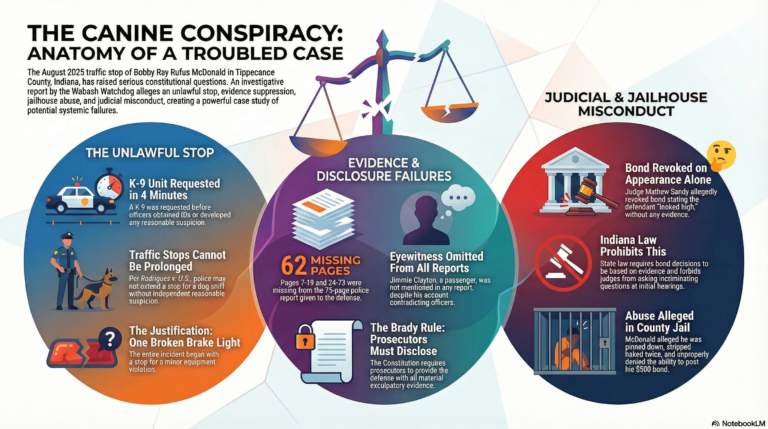
An Early K-9 Request with No Legal Foundation
The CAD log shows that by 2:17:35 a.m., Deputy Peterson had already transmitted:
“REQUESTING K9.”
The events surrounding this case have led many to believe in a broader narrative known as the Canine Conspiracy, where K-9 units are deployed under questionable circumstances.
This request came:
- Before obtaining IDs
- Before observing alleged suspicious behavior
- Before developing any reasonable suspicion
- While still conducting mission-related tasks for the traffic violation
Under the U.S. Supreme Court’s ruling in Rodriguez v. United States, a police officer may not prolong a traffic stop or convert it into a drug investigation without independent reasonable suspicion, which must be based on articulable facts.
No such facts existed at the time the K-9 was requested.
The legal implication is clear:
The K-9 request was unconstitutional the moment it was made.
Conflicting Officer Reports and a Missing Eyewitness
Deputy Peterson’s written report states that McDonald:
- tried to walk away quickly,
- refused to identify himself, and
- attempted to discard contraband beneath his phone.
Deputy Sapp’s report claims he saw McDonald “moving leaves and sticks around him” and later found drugs near where McDonald had been sitting.
However:
✔️ No officer claims they saw McDonald actually discard narcotics
✔️ No contraband was found on McDonald’s person
✔️ The alleged items were found in a public grassy area
✔️ Their reports contradict each other
✔️ Their reports contradict the CAD timeline
And most notably:
The eyewitness sitting in the middle — Jimmie Clayton — was omitted entirely from all police reports, despite providing his ID to an LPD officer who arrived on scene.
Clayton’s omission raises serious Brady concerns, as he directly contradicts key officer allegations.
In Clayton’s eyewitness account:
- McDonald sat in the grass because deputies ordered him to.
- He picked up his phone only after officers accused him of hiding something.
- The K-9 never alerted.
- No one in the vehicle possessed drugs.
Missing Discovery: Pages 7–19 and 24–73 of a 75-Page Report
The incident report provided to the defense is labeled as 75 pages, but is missing:
- Pages 7 through 19
- Pages 24 through 73
These gaps encompass:
- narrative detail
- photographic logs
- supplemental statements
- body-camera references
- internal communications
Such omissions are not routine. They severely compromise the transparency and completeness of the State’s evidence.
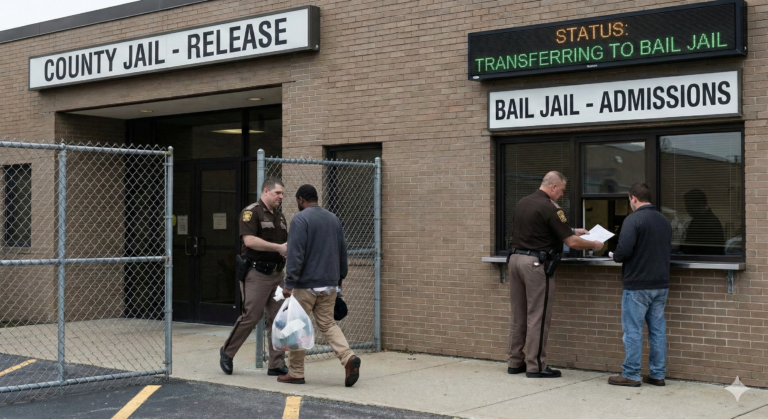
Tippecanoe CountyInside the Jail: Allegations of Abuse, Punitive Treatment, and Denial of Bond
McDonald’s recorded statement alleges:
- being taken to the ground by multiple officers,
- being pinned and stating “I can’t breathe,”
- being stripped naked twice,
- being kept without bedding or a mattress,
- being denied the ability to bond out despite having funds.
He states he was only allowed to post his $500 cash bond the next day when he encountered a jail officer he personally knew who intervened.
These allegations implicate:
✔ Fourteenth Amendment – excessive force & punitive conditions
✔ Eighth Amendment – denial of access to bond & unnecessary deprivation
✔ Due Process Clause – arbitrary interference with pretrial liberty
Such conduct, if verified, may support a federal civil rights action under 42 U.S.C. §1983.
The November 14 Hearing: Statements and Actions in Conflict with Indiana Law
At McDonald’s initial hearing before Judge Mathew Sandy, witnesses report a series of exchanges that appear inconsistent with Indiana Code § 35-33-7-5, which governs initial hearings, advisement of rights, and counsel appointment.
After reading the charges, Sandy asked McDonald if he understood. McDonald said yes.
McDonald then requested a public defender, as the statute anticipates.
Instead of moving to bond review or appointing counsel in a neutral manner required by law, Judge Sandy asked:
“Could you pass a urine screen today?”
McDonald answered honestly that he “thinks so” and wasn’t sure because he was attempting to get into treatment.
Judge Sandy responded:
“If you wanted in rehab, you’d be in rehab. If you wanted to quit smoking meth, you’d quit smoking meth.”
Under Indiana Code § 35-33-7-5, a judge at an initial hearing may not interrogate the defendant about facts related to guilt, drug use, or admissions.
Such questions violate due-process safeguards and risk compelling incriminating statements.
Witnesses say Sandy then directed McDonald to sit in the “jail seats”—a row where defendants awaiting incarceration are held—before any evidence or assessment was presented.
Prosecutors and the judge then indicated that McDonald was being sent to jail and placed on direct placement with Community Corrections (TCCC) without:
- an IRAS PAT assessment,
- or any statutory basis.
Finally, Sandy revoked McDonald’s bond based solely on appearance, stating that he “looked high.”
This conflicts directly with:
✔ Indiana Code § 35-33-7-6 (bond decisions must be based on evidence)
✔ Administrative Rule 26 (requires validated assessments for pretrial placement)
✔ Judicial Canons requiring impartiality and prohibition of bias
Appearance alone is not legal evidence, and cannot justify bond revocation.
A Growing Controversy
The McDonald case now raises serious questions:
- Was the stop unlawfully prolonged?
- Did deputies misstate or overstate their observations?
- Why was an eyewitness omitted from reports?
- Why are large sections of discovery missing?
- Were jail staff actions lawful?
- Did the judge follow Indiana Code during the initial hearing?
The Wabash Watchdog will continue monitoring the case as motions, hearings, and potential civil actions unfold.