WHEN JUSTICE COMMITS CRIME: PART 2
Qualified Immunity and the Policing Pipeline
Qualified immunity is often described as a narrow doctrine—a technical protection meant to shield law enforcement officers from personal liability when they make reasonable, good-faith mistakes in fast-moving situations. That description no longer matches reality.
In practice, qualified immunity functions as a structural shield that reshapes policing behavior long before any courtroom review occurs. It does not merely protect officers after the fact; it alters incentives at the point of encounter, search, detention, and arrest. The result is not simply fewer successful civil lawsuits, but a system in which constitutional violations can be anticipated, absorbed, and normalized.
To understand modern policing, qualified immunity must be understood not as a legal footnote, but as a core operating principle of the criminal justice pipeline.
From Legal Doctrine to Behavioral Signal
Qualified immunity most commonly arises in civil rights actions brought under 42 U.S.C. § 1983, which allows individuals to sue state actors for constitutional violations. The doctrine shields officers from liability unless their conduct violated a constitutional right that was “clearly established” at the time of the incident (Harlow v. Fitzgerald, 457 U.S. 800 (1982)).
Over time, the “clearly established” standard has hardened into a near-impenetrable barrier. Courts routinely require a prior case with highly specific, fact-matched precedent before liability will attach (White v. Pauly, 580 U.S. 73 (2017); District of Columbia v. Wesby, 583 U.S. 48 (2018)). Broad constitutional principles are deemed insufficient. Novel abuses are immunized precisely because they are novel.
This evolution transforms qualified immunity from a defensive doctrine into a behavioral signal. Officers learn—through training, experience, and institutional culture—that even unconstitutional conduct is unlikely to produce consequences unless it has already been condemned in an almost identical case.
When immunity is assumed at the front end, restraint becomes optional.
Why Suppression Rarely Corrects the System
In theory, the exclusionary rule deters unconstitutional policing by suppressing illegally obtained evidence (Mapp v. Ohio, 367 U.S. 643 (1961)). In practice, suppression rarely corrects systemic behavior.
Most defendants lack the resources to litigate suppression issues fully. Public defenders face crushing caseloads. Discovery is delayed. Pretrial detention creates overwhelming pressure to plead. Cases resolve long before constitutional claims are meaningfully tested.
Even when suppression is litigated, courts often avoid resolving the constitutional question itself, relying instead on doctrines such as inevitable discovery, attenuation, or good-faith exceptions (Nix v. Williams, 467 U.S. 431 (1984); Utah v. Strieff, 579 U.S. 232 (2016)). Evidence comes in. Conduct goes unaddressed. No precedent is created.
Qualified immunity and weak suppression enforcement reinforce each other: one forecloses civil remedies, the other prevents constitutional clarity.
Indiana Courts: Violations Acknowledged, Relief Denied
Indiana appellate decisions reflect this pattern clearly.
Indiana courts routinely acknowledge questionable or even improper law-enforcement conduct, yet deny meaningful remedies—either by declining to suppress evidence or by refusing to recognize civil liability.
In Cantrell v. Morris, 849 N.E.2d 488 (Ind. 2006), the Indiana Supreme Court explicitly declined to recognize a private cause of action for damages under the Indiana Constitution. Even where constitutional rights are violated, Indiana citizens are left without a state-level civil remedy.
Similarly, Indiana courts frequently acknowledge Fourth Amendment concerns while allowing cases to proceed under deferential standards. In Litchfield v. State, 824 N.E.2d 356 (Ind. 2005), the court articulated Indiana’s independent search-and-seizure test under Article 1, Section 11—yet subsequent cases have applied that test in a manner that overwhelmingly favors law enforcement discretion.
At the federal level, Indiana cases applying qualified immunity often follow the same pattern: courts assume arguendo that a constitutional violation may have occurred, then grant immunity because no “clearly established” case exists on point (see Pearson v. Callahan, 555 U.S. 223 (2009)).
The result is doctrinal stagnation. Violations are observed, sometimes criticized, but rarely corrected.
Risk Transfer: From the State to the Citizen
Qualified immunity shifts risk.
Instead of the state bearing the cost of unconstitutional action, that cost is transferred to the individual: loss of liberty, employment disruption, pretrial detention fees, supervision costs, housing instability, and psychological harm. None of this requires a conviction.
Indiana’s refusal to provide a state-law damages remedy ensures these costs remain externalized. Federal § 1983 litigation—dominated by qualified immunity—becomes the only path, and for most citizens, it is functionally closed.
The Policing Pipeline Effect
Qualified immunity feeds a pipeline.
Low-risk arrest decisions increase arrest frequency. Increased arrests normalize detention. Detention generates leverage—over plea negotiations, pretrial compliance, and financial extraction through supervision and fees.
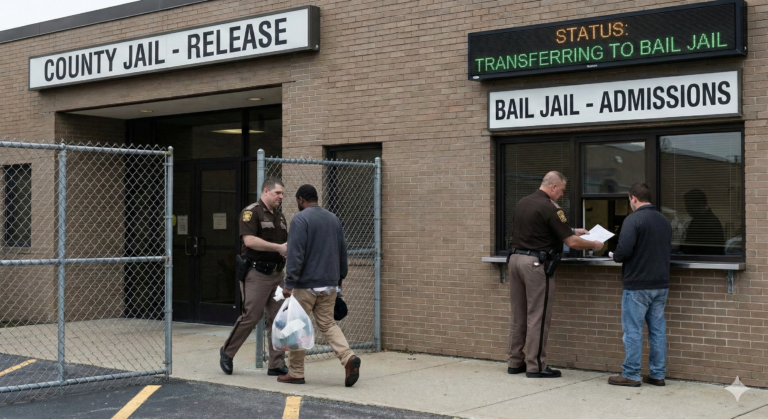
Indiana’s pretrial ecosystem—bond practices, community corrections, and fee-based supervision—depends on this steady intake. Qualified immunity ensures that upstream discretion remains insulated from downstream consequences.
The system does not require bad actors. It requires insulation.
Normalization of Constitutional Violations
When violations rarely produce consequences, they cease to be viewed as violations. They become procedure.
Stops without meaningful suspicion. Searches justified after the fact. Arrests based on thin or conclusory affidavits. These practices persist because the system has adapted to tolerate them.
Courts may acknowledge error while granting immunity. Agencies face no cost. Behavior continues.
Where Qualified Immunity Has Been Curtailed—and What That Reveal
Qualified immunity is often portrayed as immovable federal law. It is not.
States retain authority to create state-law causes of action for constitutional violations and to define defenses. Several have acted.
Colorado enacted a civil rights statute barring qualified immunity as a defense to state constitutional claims (Colo. Rev. Stat. § 13-21-131). New Mexico followed, creating a similar cause of action with mandatory governmental indemnification (N.M. Stat. Ann. § 41-4A-1).
These reforms did not eliminate policing. They changed incentives. Constitutional compliance became an institutional cost rather than a private burden borne by citizens.
No federal permission was required. Only political will.
SIDEBAR: Qualified Immunity — Reform States vs. Indiana
| Feature | Reform States (CO, NM) | Indiana |
|---|---|---|
| State constitutional damages remedy | Yes | No (Cantrell v. Morris) |
| Qualified immunity barred by statute | Yes | No |
| Government indemnification | Yes | N/A |
| Ability to create new precedent | Yes | Rare |
| Cost of violations borne by state | Yes | No |
| Structural incentive to change behavior | Present | Absent |
Why Indiana Will Not Reform Qualified Immunity
Indiana’s resistance is not accidental. It is structural.
Law enforcement, prosecutors, courts, jails, and community corrections are funded through overlapping mechanisms. Accountability is diffuse. Qualified immunity preserves that equilibrium by minimizing exposure, discovery, and institutional risk.
Reform would disrupt arrest-driven workflows that sustain pretrial detention, supervision programs, and fee-based alternatives. From an institutional standpoint, qualified immunity works.
Insulation as Policy Choice
Indiana’s silence on qualified immunity is a policy choice.
By declining to create state remedies, Indiana ensures most constitutional violations never produce adjudicated findings or compensation. Accountability is outsourced to a federal system structurally disinclined to impose it.
The system functions efficiently—and insulated.
Connecting Back to the Pipeline
Part I identified the point of origin: discretionary encounters.
Part II explains the insulation: qualified immunity and the absence of state-level remedies.
Together, they reveal a system not failing accidentally, but succeeding at its own priorities.
Part III will examine how this insulated arrest enters Indiana’s pretrial release framework—how bond, risk assessments, and community corrections convert discretion into prolonged punishment before guilt is ever adjudicated.
A system protected from accountability does not self-correct.
It optimizes.